WordPress cache and optimization
Celeris saves every page as HTML and lets the web server return it directly. No PHP, no database, no waiting — plus everything else: used CSS, deferred scripts, on-demand images.
Yearly license · No mandatory third-party service · Your data stays on your serverEach feature is a switch, with its own exclusions. Turn them on one at a time, check, move on.
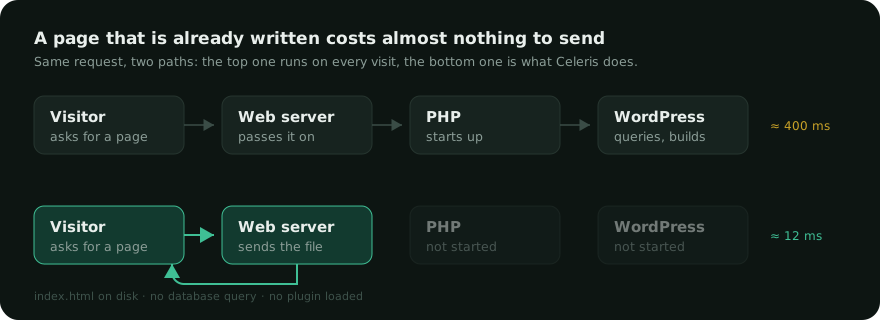
HTML files served by Apache or Nginx without starting PHP. Separate mobile cache, precompressed gzip, targeted purge on every change.
Every page is analysed in the background: only the styles it uses are inlined, the rest loads without blocking rendering.
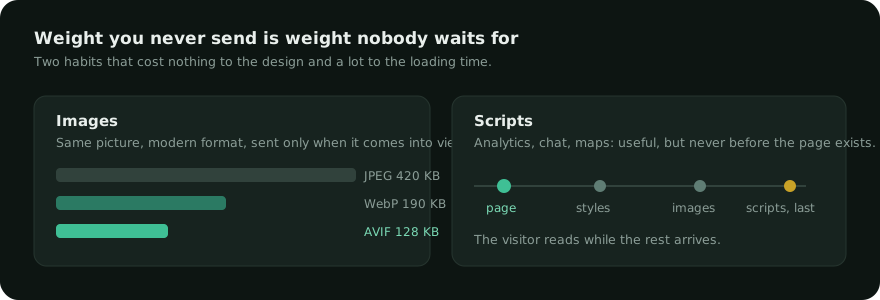
Trackers, chats and maps only start on the first user interaction. Everything else is deferred after rendering.
Lazy loading, missing dimensions filled in, WebP and AVIF generated and served, YouTube and Vimeo replaced by their thumbnail.
Response time with and without Celeris, PageSpeed scores before and after, right from your WordPress dashboard.
Apache rules written for you, Nginx snippet provided, purge relayed to Varnish and Cloudflare, rewriting to your CDN.
Measured, not promised
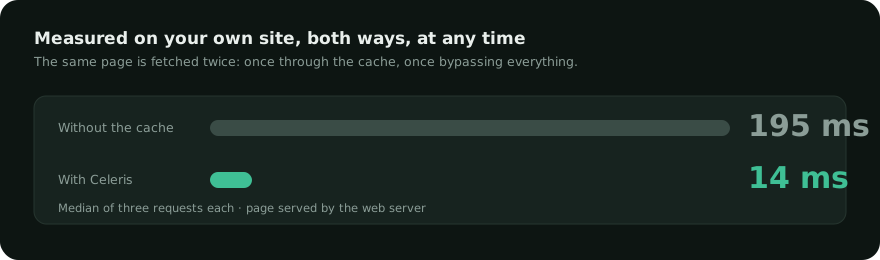
Celeris knows how to serve your site without itself. The "Measure" button compares both live: not a screenshot of someone else's site — your own numbers, on your own server.
Server response time, median of three requests, home page of a WooCommerce demo site.
Every feature in every plan. The only difference is the number of sites.
Prices are excluding VAT. VAT is added at checkout according to your country; EU businesses with a valid VAT number are charged without it. Secure payment by Stripe. Yearly plans renew automatically and can be cancelled anytime from your account.
Yes, feature for feature: cache, minification, defer, delayed scripts, used CSS, images, preloading, database. Two things differ. Used CSS is worked out on your own server, from the HTML your site already produces, so no page leaves for a third-party service. And the before and after measurements are built in rather than left to you.
Two things, both described here and in the terms of sale. Once a day the plugin reports your site address, software versions, which options are on and how many pages are cached — never content, never anything about your visitors, and the exact payload is printed in the plugin settings. And if you switch on the optional critical CSS service, the address of the page is sent to our renderer, which opens that public URL and returns the styles for the first screen. Everything else, including used CSS, is computed where your site runs.
The plugin keeps working normally. You simply stop receiving updates and support.
Apache, LiteSpeed and Nginx are supported. On Apache the rules are written automatically; on Nginx a configuration block is provided. Without server access, the cache still works through PHP.
Any time. Detach a site from your account or from the plugin, and the seat is freed immediately.
Cart, checkout and account pages are never cached; WooCommerce sessions are respected. Polylang and WPML languages are part of the cache key.
Five minutes is enough. And if it is not faster, write to us.
Choose a planAnalytics, chat, maps and fonts cost far more than their size. Three ways to make them cheap, and the ones you must…
September 9, 2026Images are 60 to 80% of a typical page. Modern formats, on-demand loading, dimensions, and the one image you must never defer.
September 6, 2026Sites are rarely slow on day one. Revisions, leftover options, plugins loading everywhere: what accumulates, how to tell which one is hurting,…
September 3, 2026